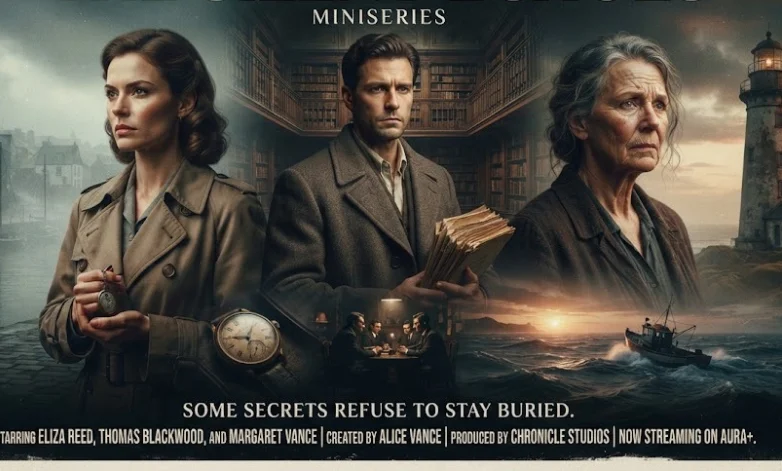
A miniseries tells one main story across a planned and limited group of television episodes. The story normally reaches a meaningful conclusion during that run. Unlike an ongoing show, it is not designed around years of renewals.
A short-run television series presents a complete story over several connected episodes. It gives writers more room than a movie while keeping a clear ending. Viewers can usually start the story knowing they will reach its conclusion without committing to several seasons.
| Key point | What it means |
|---|---|
| Story structure | One connected story with a planned ending |
| Episode count | Usually a small, predetermined number |
| Seasons | Normally designed as one complete run |
| Main appeal | More depth than a movie without a long commitment |
| Common subjects | Drama, history, crime, biographies, and book adaptations |
| Modern label | Often marketed as a limited series |
How a Miniseries Works
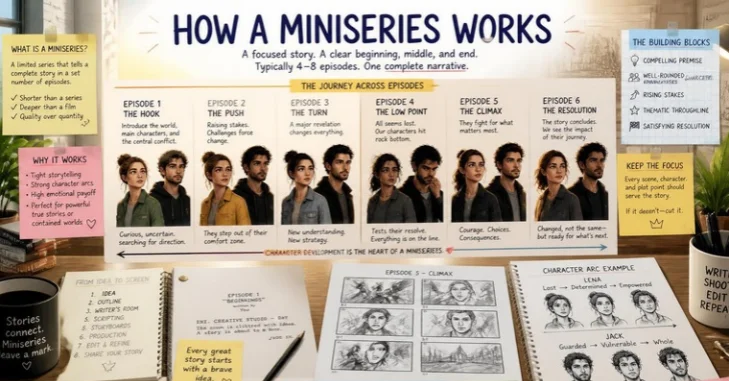
The Miniseries format sits between a feature film and an ongoing television show. A movie may have only two hours to introduce characters and finish its story. A short television run can develop those same elements across several episodes.
Writers usually know the ending before the first episode reaches viewers. That structure lets them build toward a planned conclusion instead of protecting storylines for future seasons. Major characters can change dramatically because the production does not need to preserve them indefinitely.
There is no universal episode count that defines the format. Some productions contain only a few installments, while others run considerably longer. The defining feature is a finite story rather than a specific number.
The Cambridge Dictionary describes the term as television programming broadcast in several parts over a short period. That definition reflects the format’s traditional broadcast roots. Modern streaming services use similar storytelling structures under newer labels.
Why Short-Run Television Became So Popular
One major advantage is the manageable time commitment. Viewers can follow a detailed story without signing up for several seasons. That makes the format attractive when someone wants a complete weekend watch.
The structure also works well for stories with natural endings. Historical events, true-crime cases, novels, and biographies often fit comfortably into a fixed run. Extending those stories for several seasons could add material that weakens the original narrative.
Actors can also take demanding television roles without making a long-term series commitment. Writers gain freedom because they can permanently change relationships, locations, and characters. The final episode can focus on closure rather than setting up another renewal.
Streaming has made this style even more visible. Platforms can release every episode together or schedule installments weekly. Either method gives viewers a defined amount of story before they begin.
Limited Series vs. Short-Run TV: Is There a Difference?
In everyday American television language, the two labels now overlap heavily. “Limited series” has become the more common modern industry term. The older label is still widely understood by viewers and entertainment writers.
The distinction becomes less clear when a successful show returns. Some projects are originally marketed as one-time stories before receiving another season. Others return as anthologies with new characters and an entirely different plot.
The Television Academy currently uses the category name “Limited or Anthology Series” for the Emmy Awards. That wording shows how American industry terminology has evolved. It does not mean every short-run program follows exactly the same production model.
| Format | Main story | Expected continuation | Typical structure |
|---|---|---|---|
| Short-run series | Complete within one planned run | Usually no | Connected episodes |
| Limited series | Intended to be complete | Usually no | Connected episodes |
| Anthology series | New story can begin later | Yes, with changes | Different story by season or episode |
| Regular TV series | Continues across seasons | Often yes | Ongoing characters and storylines |
How It Differs From a Regular TV Series
An ongoing television series is designed with continuation in mind. Writers may leave relationships unresolved, introduce new conflicts, or end seasons with cliffhangers. Those choices give the next season somewhere to begin.
A finite production has a different storytelling obligation. The central conflict normally needs a conclusion before the final credits. Writers have less reason to preserve major mysteries for an uncertain future season.
That difference can matter more than episode count. A regular streaming season might contain only eight episodes. A finite drama could contain the same number while still functioning completely differently.
MagVibes readers can see the contrast through television careers built around recurring programs. The site’s Peter Hermann profile covers roles connected with continuing shows such as Younger and Law & Order: SVU. Those productions rely on characters returning across multiple seasons.
The Craig T. Nelson career profile offers another useful comparison. Long-running series such as Coach develop characters over many seasons rather than one closed narrative. Their storytelling model depends on continuation.
Why the Format Works So Well for Books and True Stories
Novel adaptations often need more room than a feature film can provide. A two-hour movie may need to remove supporting characters, combine events, or simplify major subplots. Several television episodes can preserve more of the original structure.
True stories can benefit for similar reasons. Historical events often involve several people, locations, and timelines that need explanation. More screen time can provide context without forcing the production into an open-ended series.
A planned ending also suits stories whose outcomes are already known. The dramatic question becomes how events unfolded rather than whether the show will continue. Writers can structure every episode around movement toward that known endpoint.
This approach can help viewers stay focused as well. Each installment has a defined place inside the larger narrative. The audience knows the story is moving toward a conclusion rather than an indefinite extension.
What Makes a Strong Short Television Event?
A strong production uses its limited running time deliberately. Every episode should move the main plot, deepen a character, or reveal important information. There is less room for unrelated side stories that do not affect the ending.
Pacing still matters because short does not automatically mean fast. Some stories benefit from quiet character development before major events occur. The key is that those scenes contribute to the central arc.
A satisfying ending is especially important in this format. Viewers often choose finite television because they expect closure. An unresolved finale can therefore feel more frustrating than the ending of a regular season.
Casting can also shape the experience. A contained production may attract performers who cannot commit to several years of television. That can give viewers film-level talent within a longer storytelling format.
For more screen-focused coverage, MagVibes also has a guide to Jenna Ortega’s movies and TV shows. Her career shows how modern performers move between movies, streaming productions, and continuing television projects. Those boundaries have become increasingly flexible.
How to Tell Whether a Show Fits the Format
Do not rely only on the episode count. Instead, check how the network or streaming service officially describes the production. A six-episode season can still belong to a continuing series.
Look at the central story as well. If the main conflict begins and resolves within the same planned run, the show has the strongest sign of finite storytelling. A finale designed mainly to launch another season suggests an ongoing structure.
You can also check renewal announcements carefully. Marketing language sometimes changes after a program becomes successful. A project originally presented as limited may later receive a continuation.
These quick checks usually answer the question:
* Does the central story conclude during the initial run? * Was the episode count planned before release? * Does the official platform describe it as limited? * Are the main characters expected to return? * Does the finale provide closure instead of a major continuation hook?
Why U.S. Viewers Often Prefer the Format
American streaming audiences now have more television choices than they can realistically finish. A complete short-run story offers a lower commitment than a show with several seasons. That can make choosing the next program easier.
The format also removes some renewal uncertainty. Viewers of ongoing shows may wait months to learn whether a canceled series will resolve its cliffhanger. A planned finite story is designed to provide an ending from the beginning.
That does not guarantee every finale will satisfy every viewer. It does create clearer expectations about the commitment and narrative structure. For busy viewers, that predictability can be a major advantage.
People who enjoy entertainment profiles can browse the broader MagVibes entertainment section. The site covers actors, television careers, movies, and other American pop-culture topics. Those stories can help viewers find performers and programs worth exploring next.
The Takeaway for Viewers
Short-run television works because it combines the depth of episodic storytelling with a planned destination. You get more character development than most movies can provide. You also avoid the commitment required by a show stretching across many seasons.
The easiest way to recognize the format is to focus on story intent. Look for a fixed run, a central narrative, and an ending built into the original plan. Episode count alone cannot tell you whether a production truly fits.
For U.S. viewers browsing crowded streaming libraries, that distinction is useful. It tells you how much time you are committing before pressing play. It also helps set expectations about whether the final episode should complete the story.
Frequently Asked Questions
What is a miniseries?
It is a television story presented across a predetermined and limited set of episodes. Its main narrative is normally designed to conclude within that original run. The format gives viewers more storytelling depth than a movie without requiring several seasons.
How many episodes does a short-run television series usually have?
There is no universal number that applies to every production. Many modern limited programs contain several episodes, but length varies according to the story. Narrative completeness matters more than hitting a particular episode count.
Is a limited series the same thing?
The terms are often used almost interchangeably in everyday American entertainment coverage. “Limited series” is now more common in streaming and industry language. Individual networks can still use labels differently when describing their programs.
Can a limited show get a second season?
Yes, because business decisions can change after a successful release. Some shows return with the same characters, while others become anthology-style productions. A later renewal does not change how the first release may have been marketed.
Is this format better than a regular TV series?
Neither structure is automatically better for every story. Finite television works well when the plot has a natural endpoint. Ongoing television works better when characters and conflicts can support continued development.