Ever stood in front of the mirror wondering whether a mole needs attention or felt a twinge in your chest and wished you could get a quick check without an appointment? With a few reliable tools and simple routines, many basic medical checkups you can do at home will help you spot changes early, track progress, and feel more in control of your health.
Why home health checks are worth adding to your routine
Home health monitoring is about empowerment and prevention. Regular self-checks can help you notice trends—rising blood pressure, changes in sleep, or slower recovery after workouts—so you can make informed decisions or seek care sooner. These at-home assessments are not a substitute for professional medical evaluation, but they can complement regular checkups and telehealth visits.
Essential medical checkups you can do at home
Below are practical, evidence-based self-checks you can perform with minimal equipment. Keep a small log (paper or app) and note date/time and results to track trends.
1. Heart rate and pulse checks
How to: Find your radial pulse (inside of the wrist) or carotid (neck). Count beats for 60 seconds or 30 seconds and multiply by two. Resting heart rate gives insight into cardiovascular fitness and stress.
Tip: Take your resting heart rate first thing after waking for a consistent baseline. A sudden, sustained increase may signal illness, poor sleep, or overtraining.
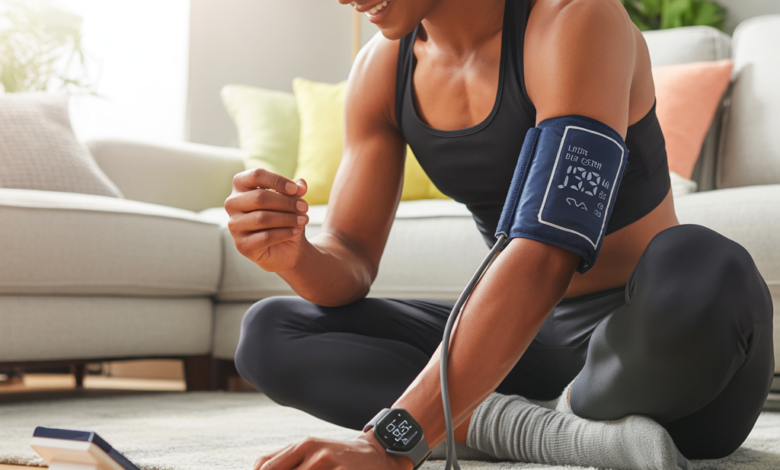
2. Blood pressure at home
How to: Use an automated upper-arm cuff validated for home use. Sit quietly for five minutes, feet on the floor, back supported. Take two readings one minute apart and record both.
Tip: Measure at the same time each day. If you get readings that are consistently high or very low, contact your clinician.
3. Temperature and fever checks
How to: Use a digital oral, tympanic, or forehead thermometer per manufacturer instructions. Track trends rather than one-off values.
4. Oxygen saturation and respiratory rate
How to: A pulse oximeter clipped to a fingertip gives SpO2 and pulse. Count breaths per minute quietly for respiratory rate. Low oxygen or trouble breathing requires prompt medical evaluation.
5. Blood glucose monitoring (when advised)
How to: If you have diabetes or your doctor recommends it, use a glucometer with proper training on fingerstick technique. Record values along with meals and medications.
Note: Only perform glucose testing under guidance if you’re not diagnosed—misinterpretation can be harmful.
6. Urine dipstick and simple home tests
How to: Over-the-counter urine test strips can screen for things like glucose, blood, or protein. Follow package directions and discuss abnormal results with a clinician.
7. Skin and mole self-exam
How to: Once a month, check your skin in a well-lit room with a full-length mirror. Look for new, changing, itchy, or bleeding moles. Use the “ABCDE” rule as a memory aid: Asymmetry, Border, Color, Diameter, Evolving.
8. Mental health and sleep check-ins
How to: Do a weekly mood and energy log. Ask yourself if sleep, appetite, or interest in activities has changed. Use short screening questions or journaling to detect persistent low mood or anxiety, and reach out for support when needed.
9. Fitness and functional checks
How to: Simple fitness assessments double as health checks. Try a timed one-minute plank, maximal push-ups in 60 seconds, or a three-minute step test to assess cardiovascular recovery (see example below).
Quick fitness checks and workout variations you can do at home
These tests both assess capacity and can be turned into workouts—helpful for monitoring progress.
- Push-up test: Do as many quality push-ups as possible in 60 seconds. Progression: start with wall or knee push-ups and move to full push-ups.
- Plank hold: Time how long you can hold a proper forearm plank. Aim to increase by 10–20 seconds weekly.
- 3-minute step test: Step up and down on a 12-inch step at a steady pace for 3 minutes. Measure heart rate at 1 minute post-exercise to assess recovery.
- Mini HIIT session: 20 seconds work / 10 seconds rest for 8 rounds (e.g., burpees, squats, mountain climbers) to gauge endurance and VO2 feel.
Real-world example: Sarah, a busy teacher, used the plank and push-up tests monthly. Over six months she increased her plank time from 45 to 90 seconds and noticed less low-back discomfort—an early sign her core conditioning helped daily posture.
When to contact a healthcare professional
Home checks are screening tools. Seek immediate care if you have chest pain, severe shortness of breath, fainting, severe bleeding, or sudden neurological symptoms. Contact your primary care provider if home readings are persistently abnormal or if you’re unsure how to interpret results.
Practical tips to make home checks sustainable
- Set a routine (same time of day, same position) for readings.
- Use a simple log or app to track trends—numbers are most useful when compared over time.
- Invest in basic, reliable tools: digital thermometer, upper-arm blood pressure cuff, pulse oximeter, and a bathroom scale with body weight tracking.
- Combine checks with short workouts or healthy habits—do a brief mobility flow after measuring blood pressure or pair a step test with your morning walk.
Frequently Asked Questions
1. Are home medical checks accurate?
Many at-home devices (validated blood pressure cuffs, digital thermometers, pulse oximeters) are accurate when used correctly. Accuracy depends on quality of the device and proper technique—read manuals and follow testing protocols. If in doubt, compare readings with a clinical device during a visit.
2. How often should I perform these checks?
It depends on the check and your health status. Basic checks like resting heart rate and mood can be done weekly; blood pressure may be twice daily when monitoring hypertension; skin exams monthly. Follow your clinician’s advice for condition-specific schedules.
3. Can home checks replace doctor visits?
No. Home checks complement professional care by helping you track changes and provide data for telehealth or clinic visits. They are not substitutes for diagnosis, treatment, or emergency care.
Conclusion — Take one small step today
Medical checkups you can do at home give you powerful information with minimal time investment. Start with one simple measure—take your resting heart rate or perform a skin self-exam—and add another next week. Track results, try a short home workout from our workout routines, and pair changes with nutrition advice in our nutrition guides. For lifestyle and habit tips that support these checks, explore our wellness tips.
Ready to take action? Choose one home check now, log the result, and set a reminder to repeat it in a week. If anything looks off, reach out to your healthcare provider—early attention matters.
For those interested in fitness and workout routines, you might also find our article on First Day of Workout Tips useful.
For those interested in fitness and workouts, you might also find our Hiit Swim Workout useful.
For more information on home office setup that can promote comfort during self-checks, check out this Modern Simple Office Table Design.