Have you ever caught yourself slouching at your desk and wished your core felt stronger and more reliable? Or felt a twinge in your lower back after a long day and wondered if better ab work could help? If so, you’re not alone — and stability ball crunches might be the simple, effective answer you’ve been looking for.
Why stability ball crunches work
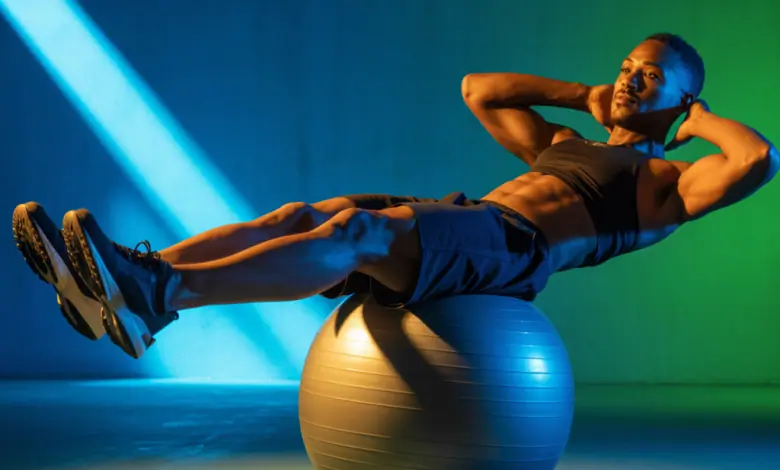
Stability ball crunches (also called Swiss ball crunches or exercise ball ab exercises) force your core muscles to work harder than a standard floor crunch because the unstable surface recruits deep stabilizers: the transverse abdominis, obliques, and even muscles in your hips and lower back. That translates to improved core stability, better posture, and a lower risk of injury during everyday movements and athletic activities.
Benefits at a glance
- Improves core strength and functional stability
- Enhances balance and proprioception
- Reduces neck strain compared with some floor crunch variations
- Scalable for beginners through advanced exercisers
How to perform stability ball crunches safely (step-by-step)
Technique matters. Follow these steps to get the most from each rep while protecting your spine:
- Select the right ball: sit on the ball and make sure your hips are about level with your knees. Common sizes: 55 cm for 5’1″–5’8″, 65 cm for 5’9″–6’2″.
- Positioning: walk your feet forward and roll the ball under your lower back so the curve supports your lumbar spine. Feet should be flat and hip-width apart.
- Engage your core by tucking your pelvis slightly — avoid overarching the lower back.
- Place hands lightly behind your head or crossed over your chest. Keep your chin lifted, as if holding an apple under it to avoid neck strain.
- Exhale as you curl up, lifting your sternum toward the ceiling using your abdominals; inhale as you lower with control. Aim for a small, controlled range of motion — 30–45 degrees of flexion is enough.
Workout structure: routines and progressions
Incorporate stability ball crunches into a balanced core routine 2–3 times per week. Here’s a sample progression you can follow:
Beginner session (Weeks 1–3)
- Basic stability ball crunch — 3 sets of 12–15 reps
- Plank on knees — 3 sets of 20–30 seconds
- Bird-dog — 2 sets of 8–10 reps per side
Intermediate session (Weeks 4–8)
- Oblique ball crunch (twist at the top) — 3 sets of 10–12 reps per side
- Reverse stability ball crunch — 3 sets of 12–15 reps
- Ball plank (forearms) — 3 sets of 30–45 seconds
Advanced session
- Ball jackknife (knees toward chest from plank on ball) — 3 sets of 8–12 reps
- Weighted sit-up on ball (light dumbbell or plate) — 3 sets of 8–10 reps
- Pike to stability ball — 3 sets of 6–10 reps
Variations to enhance results
Mix up your exercise ball core workout to target different muscles and avoid plateaus:
- Oblique crunches — rotate and lift to target the side abs.
- Reverse ball crunches — focus on the lower abs and hip flexors.
- Pike and roll-outs — challenging for stability and upper abs.
- Combination moves — pair with a resistance band or light weight for progressive overload.
Practical tips to maximize gains
Small habits make big differences. Use these practical tips to get stronger safely and faster:
- Quality over quantity: focus on controlled reps rather than rushing through high numbers.
- Breathe correctly: exhale on the exertion (the crunch) and inhale on the return.
- Warm up: 5–7 minutes of dynamic movement (walking, leg swings) reduces injury risk.
- Recovery matters: allow 48 hours between intense core sessions for muscle repair.
- Consistency is key: aim for small, regular workouts rather than sporadic long sessions.
Integrate core work into real life
Think beyond the gym. I often recommend simple ways to apply stability training in daily routines. For example, try a quick set of 12 ball crunches before showering in the morning, or sneak a 2-minute ball plank into a TV commercial break. Runners and cyclists benefit from a stronger core through better posture and force transfer — I know a recreational runner who shaved 20 seconds off her 5K after six weeks of consistent ball-based core work.
Healthy lifestyle advice to support core strength
Stronger abs come from more than just exercises. Support your workouts with balanced nutrition, sleep, and mobility work:
- Nutrition: prioritize lean protein for muscle repair, whole grains for steady energy, and healthy fats for hormonal balance. See our nutrition guides for meal ideas that support training.
- Hydration: muscles perform better when well-hydrated.
- Sleep: 7–9 hours aids recovery and strength gains.
- Mobility: hip flexor and thoracic mobility reduce compensations during crunches.
Common mistakes to avoid
- Pulling on the neck: keep your hands light behind the head and lead with the chest.
- Using momentum: slow, controlled movements recruit muscles more effectively.
- Overarching the lower back: maintain a gentle pelvic tuck to protect the spine.
- Too much range: small ranges on the ball are more effective for core activation than exaggerated sit-ups.
Enhance your core strength with stability ball crunches — getting started
If you’re ready to build a stronger, more resilient midsection, grab an exercise ball and start with the beginner session above. Whether you’re following a full-body program or just looking to add efficient ab work between tasks, stability ball crunches are an accessible, scalable way to challenge your core.
Frequently Asked Questions
1. Are stability ball crunches better than floor crunches?
Stability ball crunches often recruit more stabilizing muscles and can be gentler on the neck and lower back when performed correctly. They challenge balance and core coordination, while floor crunches may be easier for beginners to learn. Both have a place in an effective core program.
2. How often should I do stability ball crunches?
Aim for 2–3 dedicated core sessions per week. You can perform stability ball crunches within those sessions — starting with 2–3 sets of 10–15 reps and progressing as you get stronger. Allow 48 hours of rest between intense core workouts.
3. Can stability ball crunches help with lower back pain?
When done with proper pelvic positioning and controlled technique, stability ball exercises can strengthen the muscles that support the lower back and improve posture. However, if you have acute pain or a diagnosed spinal condition, consult a healthcare professional before starting.
Conclusion — take action today
Enhance your core strength with stability ball crunches by adding them to your weekly routine, focusing on technique, and supporting your training with good nutrition and recovery. Start small, be consistent, and track progress — even short, regular sessions produce noticeable improvements in posture, balance, and everyday comfort. Ready to build a stronger core? Check out our workout routines for full sessions that include stability ball progressions, and visit our wellness tips page for recovery and mobility strategies. Grab a ball, try the beginner session today, and commit to 4 weeks — you’ll be surprised at the difference.