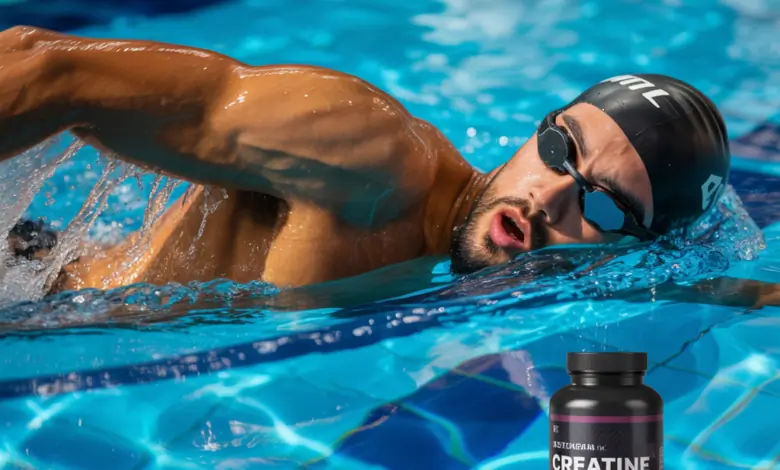
Have you ever been two strokes away from a personal best and felt your legs turn to glue? Or watched your coach call for another 8 x 25 sprint set and wondered how to maintain max power each rep? If you’re a swimmer chasing faster times, better sprint repeats, and quicker recovery between sets, creatine might be one of the simplest evidence-based tools to consider.
Creatine for Swimmers: What It Is and How It Helps
Creatine is a naturally occurring compound stored in muscles that helps regenerate ATP — the cell’s immediate energy currency. For swimmers, especially sprinters and those doing repeated high-intensity efforts, creatine supplementation (most commonly as creatine monohydrate) can improve short-distance speed, power output, and the ability to repeat sprints with less drop-off.
Key benefits relevant to swim training include:
- Increased peak power during short sprint efforts (10–100m).
- Improved recovery between high-intensity reps and training sessions.
- Enhanced muscle strength for starts, turns, and explosive underwater kicks.
- Support for muscle mass gains when combined with resistance training, which can translate into more forceful strokes.
Who Can Benefit — And Who Should Be Cautious
Competitive vs. Recreational Swimmers
Competitive sprinters and swimmers who include dryland strength work will likely notice the largest benefits from creatine. Recreational or long-distance swimmers may get smaller performance gains because creatine targets short, explosive energy systems rather than long aerobic endurance.
Adolescents, Health Conditions, and Safety
Creatine is one of the most researched supplements and is generally safe for healthy adults when used responsibly. Teens should consult a physician and their coach before starting any supplement — many youth sports programs require medical approval. Anyone with kidney issues or on medication should speak with a healthcare provider first.
How to Use Creatine Safely: Dosing, Timing, and Forms
For most swimmers, creatine monohydrate is the recommended form due to strong evidence for efficacy and safety. Here’s a simple, practical dosing approach:
- Loading (optional): 20 g/day split into 4 doses for 5–7 days to saturate muscles quickly.
- Maintenance: 3–5 g/day thereafter for ongoing benefits.
- No loading: You can also skip loading and take 3–5 g/day; muscles will become saturated in ~3–4 weeks.
Timing matters less than consistency, but taking creatine after training with a carbohydrate-protein snack can slightly improve uptake. Important practical tips:
- Stay well-hydrated — creatine draws water into muscle cells.
- Mix with water or a post-workout shake; creatine monohydrate dissolves best in warm liquids.
- You don’t need to cycle off creatine; long-term daily use at maintenance doses is common and well-studied.
Practical Swim Workouts and Training Tips to Maximize Creatine Benefits
Creatine shines when paired with targeted workouts that tax the ATP-PCr energy system. Here are pool and dryland sessions that sync well with supplementation:
Pool Session — Sprint Repeat Set
- Warm-up: 800m mixed swim + drills
- Main: 12 x 25m at 95–100% effort, 1:30 rest (or 3–4 minutes depending on level) — focus on maximal sprint, fast breakouts, and full recovery.
- Secondary: 6 x 50m kick on 2:00 at race-pace intensity
- Cooldown: 400m easy
Short rest intervals that still allow near-full recovery help train repeat sprint ability — the exact adaptation creatine supports.
Dryland Strength Session — Twice Weekly
- Squats or goblet squats: 3 sets of 5–8 reps (heavy)
- Romanian deadlifts: 3 sets of 6–8 reps
- Explosive plyo: box jumps 3 x 6
- Core/emphasis: medicine ball throws 3 x 8
Pairing creatine use with 6–12 weeks of progressive strength training often yields the best improvements in start power, turns, and sprint speed.
Nutrition, Recovery, and Lifestyle Tips While Supplementing
To get the most from creatine, treat it like one piece of a broader performance puzzle:
- Eat balanced meals with adequate protein (1.4–2.0 g/kg/day for many athletes) to support muscle repair.
- Include carbs around training to replenish glycogen and aid recovery.
- Prioritize sleep — 7–9 hours per night helps neuromuscular recovery and adaptation.
- Monitor body weight — some swimmers notice a 1–3 lb water-related gain, which is normal and usually in muscle tissue and intracellular water.
For more targeted daily meal plans and nutrient timing ideas, check out our nutrition guides. To balance pool work with strength, visit our workout routines page for periodized plans.
Real-World Examples
Case study snapshots from typical athletes:
- A collegiate 50m freestyler added 3 g/day of creatine and two focused dryland sessions per week. After 8 weeks, she reported sharper starts and improved repeat-25 times during training.
- A masters swimmer used a 5 g/day maintenance dose and noticed less fatigue during club sprint sets and improved recovery between morning and evening practices.
Frequently Asked Questions
Is creatine safe for teenage swimmers?
Many experts recommend caution: teens interested in creatine should discuss it with a physician, and parents/coaches should be informed. Focus first on nutrition, sleep, and strength training; if creatine is considered, do so under medical guidance.
Will creatine make me bulky or slow me down?
Creatine can cause modest weight gain due to increased muscle water content and, over time, muscle mass if combined with resistance training. This usually helps sprinters by increasing power; it rarely makes swimmers “bulky” in a negative way.
How long before I notice results from creatine?
If you use a loading phase, some swimmers notice improved sprint power in 1–2 weeks. If you use a maintenance-only strategy, it can take 3–4 weeks to reach full muscle saturation and see benefits.
Conclusion — Should You Try Creatine for Swimmers?
If your goal is improved sprint performance, quicker recovery between high-intensity reps, and stronger starts/turns, creatine for swimmers is a well-researched, generally safe supplement to consider. Start with 3–5 g/day of creatine monohydrate, pair it with targeted sprint and strength work, stay hydrated, and consult a healthcare professional or coach if you’re under 18 or have health concerns.
Ready to test it out? Try a 6–8 week plan that combines a maintenance dose of creatine with two focused dryland sessions and one sprint-specific pool workout per week. For training templates and meal timing ideas to complement supplementation, explore our workout routines, nutrition guides, and wellness tips. Want personalized guidance? Leave a comment or subscribe for weekly swim strength tips and supplement updates.