Picture this: mid-set on your favorite curl, you feel a sudden pop and a sharp pain — later you can’t fully bend your elbow or turn your palm up. Panic sets in. The first question that pops into your head: can I still workout with a torn bicep tendon? The short answer is: maybe — but it depends on the type of tear, your symptoms, and how you modify your training.
Can I still workout with a torn bicep tendon? What to consider
Not all biceps tendon injuries are the same. A partial tear or tendonitis might allow modified training and a carefully supervised rehab program. A complete rupture (especially distal biceps tendon rupture) often requires surgical repair for people who want full strength and function. Key factors that determine whether you can continue exercising safely include:
- Severity: partial tear vs. complete rupture
- Location: proximal (shoulder side) vs. distal (elbow side)
- Pain level and range of motion
- Functional needs (athlete vs. desk worker)
- Medical advice from your physician or physical therapist
Understand the injury: partial tear, tendonitis, or rupture?
A torn biceps tendon can range from inflammation and small tears (tendonitis or partial tears) to a complete rupture where the tendon separates from the bone. Partial tears and inflammation often respond well to conservative care: rest, physical therapy, and progressive loading. Complete ruptures, particularly distal ruptures, usually present with a visible deformity (Popeye sign), significant weakness, and often need surgical consultation.
Safe workouts and modifications
If you’ve been cleared to exercise by a healthcare professional, the goal becomes maintaining fitness while protecting the injured tissue. Below are practical, safe strategies and exercise variations.
Lower body and cardio — keep the engine running
- Leg-focused strength days: squats, lunges, Romanian deadlifts, and leg press can be done without stressing the biceps if you avoid heavy bar holds and opt for machines or safety bars.
- Cardio options: walking, cycling, elliptical, and swimming (only if shoulder/elbow motion is pain-free and approved) maintain conditioning with minimal biceps load.
- Use single-arm or neutral-grip alternatives to reduce biceps strain (e.g., use a leg curl machine instead of dumbbell hamstring work requiring arm stabilization).
Upper body — smart substitutions
- Posterior chain and back: machine rows or supported chest-supported rows put less eccentric stress on a healing biceps than heavy barbell bent-over rows.
- Push-focused days: bench press, incline press, and push-ups (modified on knees or elevated) keep chest and triceps strong while minimizing biceps involvement.
- Avoid heavy barbell curls, chin-ups, or underhand rows that load the biceps directly until cleared.
Isometric holds and mobility work
- Isometric biceps contractions (gentle, pain-free holds) can maintain neuromuscular control early in rehab under PT guidance.
- Scapular mobility, thoracic rotation, and shoulder stability exercises help prevent compensations that stress the elbow and biceps.
Rehab exercises and progressive loading
Rehab focuses on restoring pain-free range, strength, and tendon capacity. Typical progression (under a physical therapist) may include:
- Phase 1: pain management, gentle ROM, and isometrics
- Phase 2: concentric strengthening with light resistance and pain-free control
- Phase 3: eccentric loading and progressive resistance to rebuild tendon tolerance
- Phase 4: sport- or job-specific return-to-activity programming
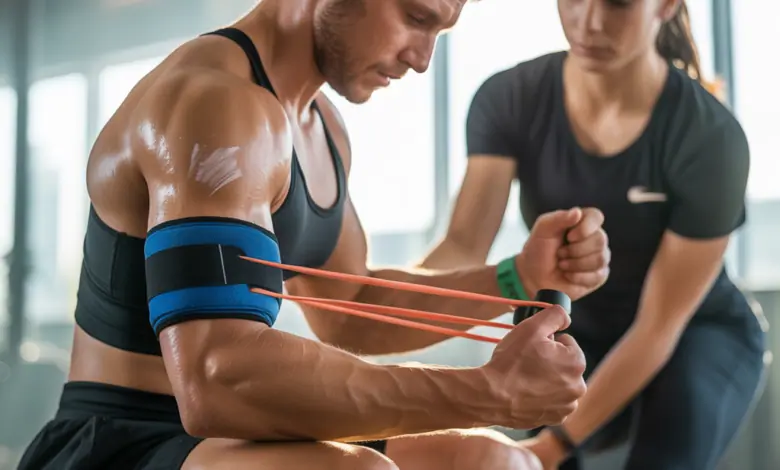
Example rehab exercises: gentle elbow flexion/extension, supination/pronation drills with light weights, eccentric lowering under control, and resisted band work progressing to dumbbells.
Practical tips for training with a biceps tendon injury
- Listen to pain: sharp, shooting pain or increased swelling are red flags — stop and consult your clinician.
- Prioritize form: poor technique increases overload on healing tendons.
- Use pain as a guide, not the only metric — stiffness and mild discomfort can be expected, but pain that worsens with activity is not acceptable.
- Keep a training log: track exercises, loads, and pain responses to inform adjustments.
- Consider cross-training: focus on mobility, lower-body strength, and cardiovascular health while the biceps heals.
Real-world examples: how others adapted
Sam, a weekend warrior, tore his proximal biceps partially during a heavy pull. After a medical evaluation, he shifted to single-leg work, sled pushes, and machine-based back exercises, and worked with a PT on eccentric biceps loading. After 12 weeks he returned to light weighted pulls and eventually regained near-full strength.
Maria, a competitive rock climber with a distal biceps rupture, chose surgical repair. Her post-op plan included protected immobilization, progressive PT, and a cautious return to climbing after months of structured loading and sport-specific training.
When to see a doctor or physical therapist
Seek immediate medical attention if you experience: a sudden loud pop, severe pain, visible deformity, significant weakness, numbness, or loss of range. For persistent pain or uncertain injury severity, a medical exam (and imaging if needed) will guide whether conservative care or surgery is the right path.
Healthy lifestyle habits that speed recovery
- Nutrition: prioritize protein, omega-3s, vitamin C, and zinc to support tissue repair — see our nutrition guides for meal ideas.
- Sleep: aim for 7–9 hours to optimize healing hormones and recovery.
- Stress management: lower stress to reduce systemic inflammation that can impair tendon healing.
- Consistency: follow progressive, structured rehab and don’t rush back to heavy loading.
Frequently Asked Questions
1. How long until I can lift heavy again after a biceps tendon tear?
Timeline varies widely. Partial tears and tendonitis may improve in 6–12 weeks with proper rehab. Complete ruptures often require surgical repair and several months of rehab (3–6+ months) before heavy lifting resumes. Always follow your surgeon or physical therapist’s timeline.
2. Can I train one arm while the other is injured?
Yes — unilateral training is commonly used to maintain strength on the non-injured side and can offer some cross-education benefits to the injured limb. Avoid exercises that inadvertently load the injured biceps through stabilization or grip demands.
3. Will a torn biceps tendon fully heal without surgery?
Some partial tears and proximal biceps issues respond well to conservative treatment. Complete distal ruptures are less likely to regain full function without surgery, especially for younger or active individuals. A medical evaluation will determine the best route.
Conclusion — your next steps
So, can I still workout with a torn bicep tendon? Often yes — with modifications, professional guidance, and smart rehab you can stay active and fit while protecting the healing tendon. First step: get a proper diagnosis. Then work with a clinician to build a progressive plan that includes pain management, mobility, and gradual loading. For practical programs, check our workout routines and explore recovery-focused wellness tips. If you found this helpful, leave a comment about your experience or subscribe for more injury-friendly training plans — stay strong, train smart, and heal well.